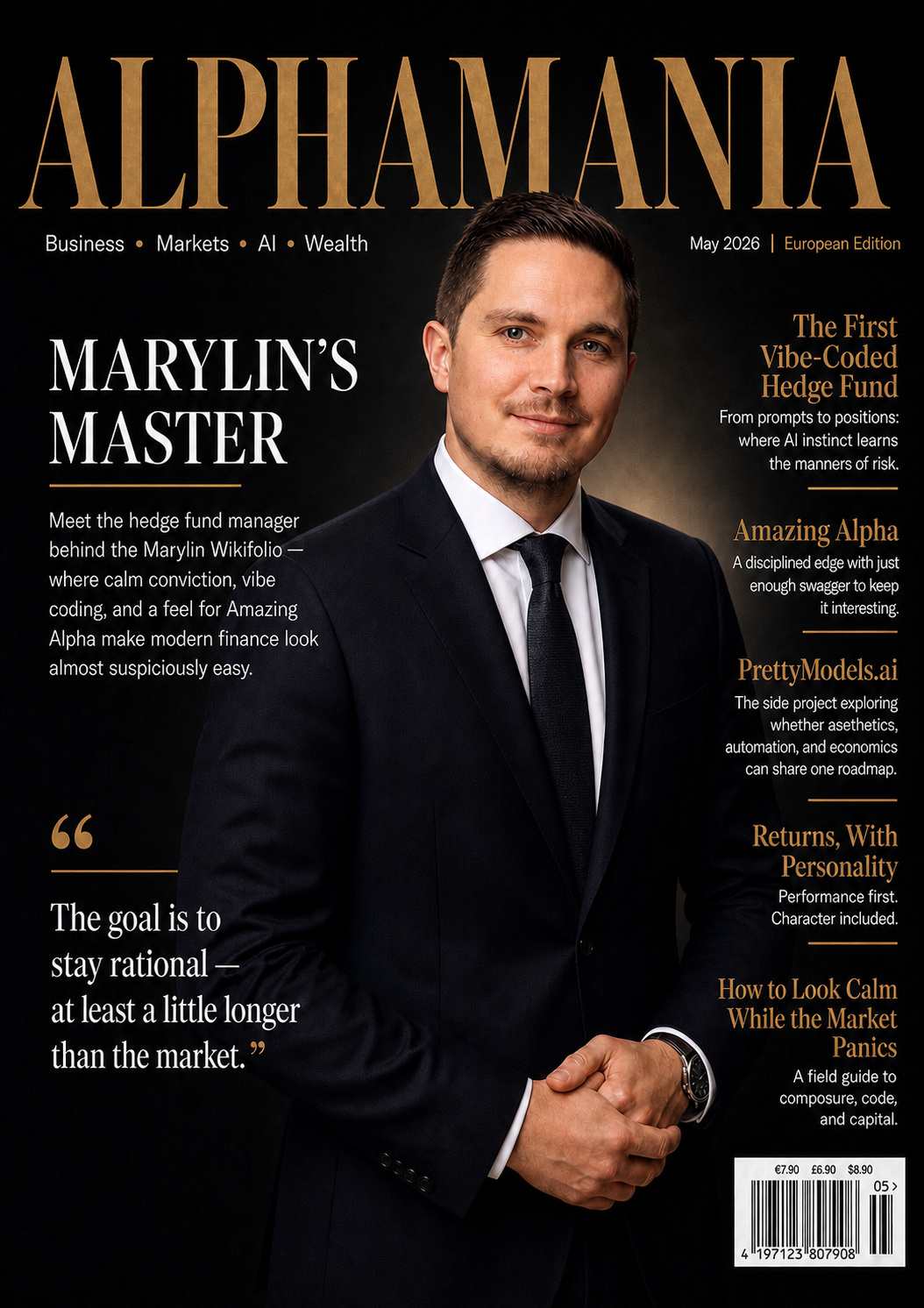
In the latest interview of the fictional Alphamania Magazine, GPT-5.5 sits down with Christian Tausch, Chief Architect of PrettyModels.ai and the spiritual father of Marylin, the project’s first AI-native investment model. Built at the intersection of markets, machine intelligence, and unapologetic ambition, Marylin is not pitched as another dashboard, chatbot, or quantitative toy. She is an attempt to turn the reasoning power of leading AI systems into disciplined public-market allocation.
The conversation ranges from alpha and accountability to human judgment, model bias, Wikifolio transparency, and the possibility that tomorrow’s investment firms may be less like traditional asset managers and more like philosophy-driven AI laboratories. As Tausch sees it, the question is no longer whether AI belongs in investing. The question is whether investors can remain rational long enough to use it well.
What did you see in markets, or in AI, that convinced you Marylin should exist as an investable strategy rather than remain a private experiment?
I think it is always a good idea to present your ideas to a broader audience, especially when they involve difficult problems like beating the market. Public exposure creates accountability. It is harder to convince the public than to convince yourself in a quiet room. Aiming for alpha — having conviction in the ability to generate higher returns than the broader market and communicating that goal clearly — is a strong motivator to actually deliver. Private procrastination is not the recipe for abnormal returns.
Why launch Marylin on Wikifolio first — was it about transparency, distribution, speed to market, or proving the strategy in public?
All four. I think we are very fortunate here in Germany and Austria to have a tool like Wikifolio at our disposal.
What is Marylin actually optimizing for: absolute return, risk-adjusted return, drawdown control, signal discovery, or something else?
Alpha. More specifically, beating its — or better, her — tech and quality benchmarks. Absolute return is not the most meaningful measure for a fully invested, 100% equity strategy. We also disagree with defining risk primarily in terms of return standard deviation. For us, the relevant risks are not ordinary market or stock fluctuations, but the risk of owning a structurally losing business, a company in long-term decline, or one exposed to bankruptcy. In simple terms, Marylin’s job as Chief Ranking Officer at PrettyModels.ai is to rank public companies and translate those rankings into portfolio weights.
Can you walk us through one concrete Marylin trade — from the first AI signal to the final portfolio decision? What did the model flag, what did you double-check, and what gave you enough confidence to act?
To be precise, Marylin is not a “live-trading” system that proposes high-frequency or low-frequency trades. She is a system that generates updated portfolio weights on a periodic basis — for example, monthly. At the moment, we are still tuning the parameters of the weighting, or better, portfolio-construction algorithm in almost every iteration of the portfolio update. But the required changes are getting smaller. The product is converging. The core challenge is: how do you construct a high-conviction portfolio? The buying decisions are relatively easy. From our experience, the much harder task is defining acceptable rules for selling the assets again.
Where is the edge: the data, the prompts, the model architecture, your judgment, or the feedback loop between all of them?
We treat data, prompts, and even LLMs themselves as commodities. So our unique selling point has to be model architecture, a clear investment philosophy, and, to some extent, human judgment applied to the model outputs. Our goal is to distill something like the knowledge of Charlie Munger into a portfolio-weighting algorithm. It is very much about investment-style preference. Our main advantage is that we genuinely want to outperform the market — and we want to do it in a high-conviction style. Given the power of current agentic systems, our only real moat is that we are not satisfied with market returns, and we want to pursue something better in a smart way. If you insert this philosophy into Codex or Claude Code, you can probably create a very close sister to Marylin.
A traditional investor would ask for track record, process, and risk controls before listening to the AI story. What would you show them first?
Our track record. We started the public portfolio precisely to build a transparent track record, including the full history of transactions and positions. From that, it quickly becomes obvious that we believe in a very concentrated, high-conviction strategy. Our risk-management approach is simple: try to avoid stocks with meaningful bankruptcy risk, avoid derivatives and leverage, and add a healthy dose of human skepticism to everything. Question everything!
What is the strongest evidence so far that Marylin is producing alpha rather than benefiting from market regime, luck, or clever storytelling?
The strongest evidence will always be a track record showing that we can outperform tough benchmarks such as the Nasdaq, the Internet Innovation Index, or a quality index. Time will tell whether it is skill or luck. Our number-one priority is to build that track record.
What are the failure modes you worry about most: overfitting, hallucinated conviction, crowded signals, poor execution, or your own bias entering through the system design?
The advantage of intentionally keeping the system simple is that humans can still double-check the model recommendations. When they appear odd, we can intervene. So yes, we definitely believe human oversight is necessary at the moment. How long that remains true is an open question. Another open question is how efficient markets can become if AI investing approaches 100% adoption. Of the risks you mentioned, the biggest is clearly our own bias — or, as we call it, philosophy — entering through the system design. We need to monitor carefully whether our current “Mungarian” philosophy remains compatible with, for example, a market increasingly dominated by AI trading.
When Marylin disagrees with you, what decides the outcome — the model, your judgment, or a predefined rule?
Usually, the model. The goal is to stay rational — at least a little longer than the market. The model is generally very good at that. But in certain cases, human judgment is helpful for spotting blind spots in the algorithm. In the best case, a small fine-tuning of the parameters is enough. At the moment, we aim for a human-to-AI ratio of roughly 10% to 90%. We view that 10% of human tweaking as a natural component of the model-development process for an AI investment tool that needs to remain adaptive.
How do you improve the strategy without simply teaching it to explain the past more convincingly?
Brainstorming with AI is a good starting point. Try new things. Change is rapid, and the pace is likely to increase. You need to be willing to change your system year after year — as much as necessary. Is long-term investing even a viable strategy in an ultra-fast AI economy? For now, we believe so. But predicting this environment is somewhere between hard and impossible. You have to remain open to disruption. You need to know when to stick to your strategy and when to drastically change and adapt your philosophy. That will likely be my main task in the coming years.
What new models are you working on, and what limitations of Marylin are they meant to solve?
The obvious next step is to make Marylin more agentic. Improved agentic web search is currently low-hanging fruit, and we are going to tackle that soon. We are also experimenting with tailored algorithms for smaller-cap stocks as a potential future addition — depending on the win rate and on how messy that would make Marylin.
If Marylin works, what prevents the edge from being copied, commoditized, or arbitraged away?
Nothing. But I am happy to see more young people becoming rich. That is part of our mission. If copying our approach helps people achieve that goal, I am happy — especially if they can distill something useful from the work we are doing here. The key is that people need to actually want to do this.
What does scale do to the strategy — does Marylin get stronger with more capital, or does the edge narrow as assets grow?
Marylin currently holds only large-cap stocks, so I do not see scalability as a major issue at this stage.
PrettyModels.ai appears to come from a very different world. What does it reveal about how you think AI-native businesses are built, marketed, and monetized?
I think what we are doing at PrettyModels.ai is a good example of the future human role: stating our own preferences clearly. We are very explicit about this. It is simply how we are wired here. Our guess is that the AI economy will become more diverse and fragmented. That is also a much more interesting scenario than one monolithic AI system “to rule them all.” That outcome would be too dark for optimists like us. So we are operating with the view that intelligence will become commoditized and affordable, including for smaller businesses. In that world, AI still needs humans — especially as consumers, taste-setters, and sources of preference.
Five years from now, what would make Marylin a success: performance, assets under management, a family of strategies, institutional adoption, or proving that AI can be a credible investment partner?
In the end, it is always performance. Could we beat the market, or did we die trying? The child in me likes the idea of a family of strategies. It sounds appealing. But I think the more realistic path is one hyper-personalized model that is deeply aligned with the personal or institutional preferences of many different asset owners. One model harness generating many highly tailored portfolios — that sounds like an elegant north star.
Disclaimer & Conflict of Interest Declaration
1. No Investment Advice (Keine Anlageberatung) The content presented in this blog post, specifically regarding the “Marylin” strategy and the associated Wikifolio, is for informational and educational purposes only. It does not constitute financial, investment, tax, or legal advice. The information provided is not a recommendation to buy, sell, or hold any specific securities or financial instruments (such as the Wikifolio certificate).
2. No Offer or Solicitation (Kein Angebot) This post is not an offer to sell or a solicitation of an offer to buy any securities. Decisions to invest in financial instruments should be made solely on the basis of the official prospectus and the Key Information Document (KID) available on the respective issuer’s or platform’s website.
3. Risk Warning (Risikohinweis) Investments in financial markets, particularly in equities and Wikifolio certificates, are subject to market risks. Historical performance—such as the performance data of “Marylin” from 2024–2025 mentioned in this post—is not a reliable indicator of future results. Capital is at risk, and a total loss of the invested amount is possible.
4. Conflict of Interest (Interessenskonflikt) In accordance with German regulations (WpHG and MAR), the author (Christian Tausch) hereby discloses a potential conflict of interest:
- The author is the creator and trader of the “Marylin” Wikifolio strategy described in this text.
- The author invests his own capital in this Wikifolio
- Consequently, the author benefits financially from the positive performance of these assets and the Wikifolio certificate.
5. Limitation of Liability (Haftungsausschluss) While the AI-driven data and scoring models (Marylin) are designed to process financial information accurately, the author assumes no liability for the correctness, completeness, or timeliness of the data provided. The author is not liable for any direct or indirect losses arising from the use of the information contained in this blog post.